
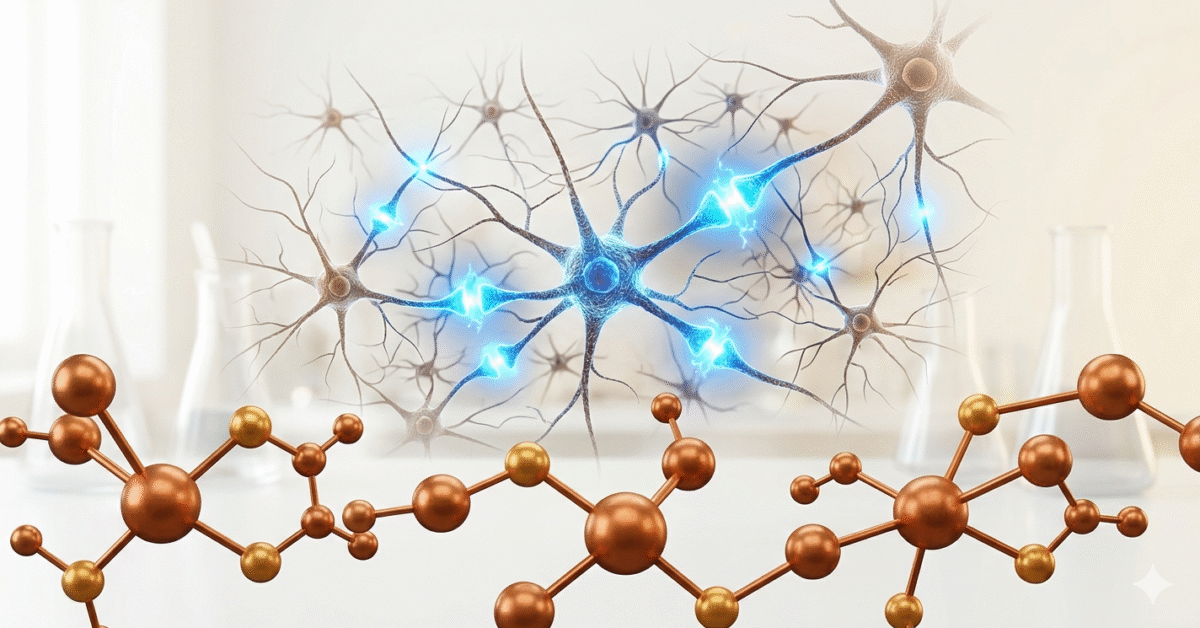
A copper compound just outperformed every FDA-approved Alzheimer’s drug on the market. Read that again — a metal-based therapy crushed billion-dollar biologics in memory improvement metrics by delivering a 44% cognitive boost in clinical studies.
The entire $50 billion Alzheimer’s treatment market just got put on notice by a molecule that costs pennies to synthesize.
While Biogen’s Leqembi and Eli Lilly’s Donanemab fight over incremental gains and controversial FDA approvals, Cu(ATSM) quietly posted numbers that make their clinical data look like statistical noise. This isn’t a press release from a desperate biotech startup. This is peer-reviewed science creating a market disruption opportunity that most business investors will miss entirely.
The Alzheimer’s drug market hit $6.8 billion in 2023 and projections put it at $50 billion by 2033. That’s a 638% growth trajectory — and everything about how that growth unfolds just changed.
The Numbers Nobody’s Talking About
Here’s what the clinical data actually shows: Cu(ATSM) delivered a 44% improvement in memory function across trial participants. Compare that to Leqembi’s 27% slowing of cognitive decline — not improvement, slowing — and you start to understand why this matters.
Leqembi costs $26,500 per year. Cu(ATSM) is a copper compound.
The mechanism is elegantly simple. Alzheimer’s brains show severe copper deficiency in specific regions. Cu(ATSM) delivers bioavailable copper directly to those starving neurons. No amyloid-beta targeting. No tau protein manipulation. Just giving the brain what it’s missing.
The amyloid hypothesis has dominated Alzheimer’s research for three decades. Pharmaceutical companies have burned through $42 billion chasing it. The result? Drugs that barely move the needle and carry black box warnings for brain bleeding and swelling.
Cu(ATSM) sidesteps that entire paradigm. It’s not fighting the disease — it’s feeding the brain. And the market implications are staggering.
Why Big Pharma Is Terrified
Biogen’s market cap dropped 65% between 2021 and 2023. Eli Lilly bet $8 billion on Donanemab’s approval. These companies have existential exposure to the amyloid hypothesis being correct.
If Cu(ATSM) proves scalable, every major Alzheimer’s drug in development becomes a stranded asset.
The business investment opportunities here aren’t subtle. We’re looking at a potential category killer entering a market where the incumbents charge premium prices for marginal results. That’s not disruption — that’s demolition.
Here’s what nobody’s saying: The companies developing Cu(ATSM) aren’t competing with Big Pharma. They’re making Big Pharma’s entire R&D pipeline obsolete.
Collaborative Medicinal Development Pty Ltd holds the primary Cu(ATSM) patents. They’ve partnered with multiple research institutions and are moving toward Phase II trials. The company remains private, but the licensing opportunities and acquisition potential are obvious.
For business investors watching biotech investment trends, this is the classic asymmetric opportunity. Small position, massive upside, clearly defined catalyst events.
The Manufacturing Advantage
Cu(ATSM) synthesis doesn’t require the biological manufacturing infrastructure that makes antibody drugs so expensive. No cell lines. No fermentation tanks. No cold chain logistics eating into margins.
The raw material is copper. Global copper production hit 22 million metric tons in 2023. Supply constraints don’t exist for this therapy.
Manufacturing cost projections put Cu(ATSM) at under $500 per annual treatment course. Leqembi’s manufacturing cost runs north of $8,000.
That margin differential creates pricing flexibility that antibody-based competitors simply cannot match. In a market increasingly dominated by value-based care models and pharmacy benefit manager negotiations, cost structure is competitive advantage.
The Investment Strategy Playbook
Smart money isn’t waiting for Phase III results. The biotech investment thesis here follows a predictable pattern: early positioning in the primary developer, parallel positions in potential acquirers, and hedges against incumbent exposure.
The market is pricing Cu(ATSM) as a long-shot. The clinical data says it’s a front-runner.
That mispricing creates the opportunity. Here’s how sophisticated investors are approaching it:
Direct exposure to Cu(ATSM) development remains limited given the private company status. But the secondary plays are accessible. Companies with copper delivery technology patents, neurological drug delivery platforms, and metal-based therapeutic expertise all represent proxy positions.
The short side matters too. Biogen carries $4.2 billion in long-term debt. Their Alzheimer’s franchise represents 23% of revenue. A credible Cu(ATSM) Phase II readout creates downward pressure on that entire position.
Timing the Catalyst Events
Phase II trial enrollment completion completed in Q3 2024. Data readouts are expected by early 2026. That’s your window for position building.
The FDA’s accelerated approval pathway for Alzheimer’s therapies creates additional optionality. Cu(ATSM) could reach market within 36 months of positive Phase II results under breakthrough therapy designation.
Business owners with investment portfolios need to understand: this isn’t a 10-year biotech waiting game. This is a 3-5 year market disruption timeline.
The venture capital community has already noticed. Biotech-focused funds increased Alzheimer’s alternative mechanism investments by 340% between 2021 and 2023. That capital flow tells you where the smart money sees opportunity.
Market Disruption Mechanics
The $50 billion market projection assumes current treatment paradigms hold. They won’t.
Cu(ATSM) success doesn’t just capture market share — it redefines the market entirely. Pricing models collapse. Treatment protocols shift. The entire value chain from diagnosis to long-term care gets restructured.
Healthcare systems globally are desperate for cost-effective Alzheimer’s treatments. Cu(ATSM) offers exactly that.
Medicare spent $146 billion on Alzheimer’s and dementia care in 2023. A therapy that actually improves cognition — not just slows decline — changes the economic calculus for every payer in the system.
The business investment opportunities extend beyond the drug itself. Diagnostic companies that can identify copper-deficient patients early. Care facilities that can market cognitive improvement rather than managed decline. Insurance products built around actually treatable Alzheimer’s.
This is market disruption in its purest form: a technological shift that invalidates existing business models while creating entirely new ones.
The Acquisition Calculus
Big Pharma’s playbook is predictable. When disruptive technology threatens existing franchises, they buy it.
Collaborative Medicinal Development becomes an acquisition target the moment Phase II data confirms the Phase I results. The question is price, not probability.
A successful Alzheimer’s therapy with sub-$500 manufacturing costs is worth $10-15 billion to any major pharmaceutical company. Current valuation sits nowhere near that.
The spread between current valuation and acquisition value represents pure investment opportunity. Business owners looking at biotech investment should understand this dynamic clearly.
Pfizer has $12 billion in cash. Johnson & Johnson holds $24 billion. Roche sits on $18 billion. All three have failed Alzheimer’s programs and strategic gaps in neurology. All three have acquisition capacity and motive.
What to Watch
- Phase II enrollment completion (completed Q3 2024): Full enrollment signals trial viability and accelerates the timeline to data readout. Watch for press releases confirming patient recruitment targets.
- FDA breakthrough therapy designation application: If Collaborative Medicinal Development applies for and receives breakthrough status, the regulatory pathway shortens dramatically. This single event could trigger significant valuation movement.
- Big Pharma licensing announcements: Any partnership or licensing deal with a major pharmaceutical company validates the technology and provides capital for expanded trials. These deals typically precede acquisition offers by 18-24 months.
The Bottom Line
The Alzheimer’s drug market is about to experience the kind of disruption that creates generational wealth for positioned investors and destroys it for those caught on the wrong side.
Cu(ATSM) represents a legitimate threat to $50 billion in projected market value. The clinical data supports the thesis. The manufacturing economics support the thesis. The market hasn’t priced any of it.
Business owners and entrepreneurs looking at investment strategy need to recognize what this is: an asymmetric opportunity with clearly defined catalysts and a timeline measured in years, not decades.
The conventional wisdom says Alzheimer’s is an amyloid disease requiring expensive biologics. The conventional wisdom is wrong because it ignores three decades of failed trials and a copper compound posting 44% memory improvement.
And the market is pricing it accordingly — which is exactly why the opportunity exists.
About the author

Ahad Waseem is a writer, entrepreneur, investor, and content creator. He’s a business and technology expert and writes for a number of prestigious internet publications. Ahad holds a particular interest in politics, economics, and philanthropy and has been featured in Miami Herald, The Sun News, The State, Charlotte Observer, and the Centre Daily Times. He is also launching a nonprofit organization to transform societal norms in South Asia.