
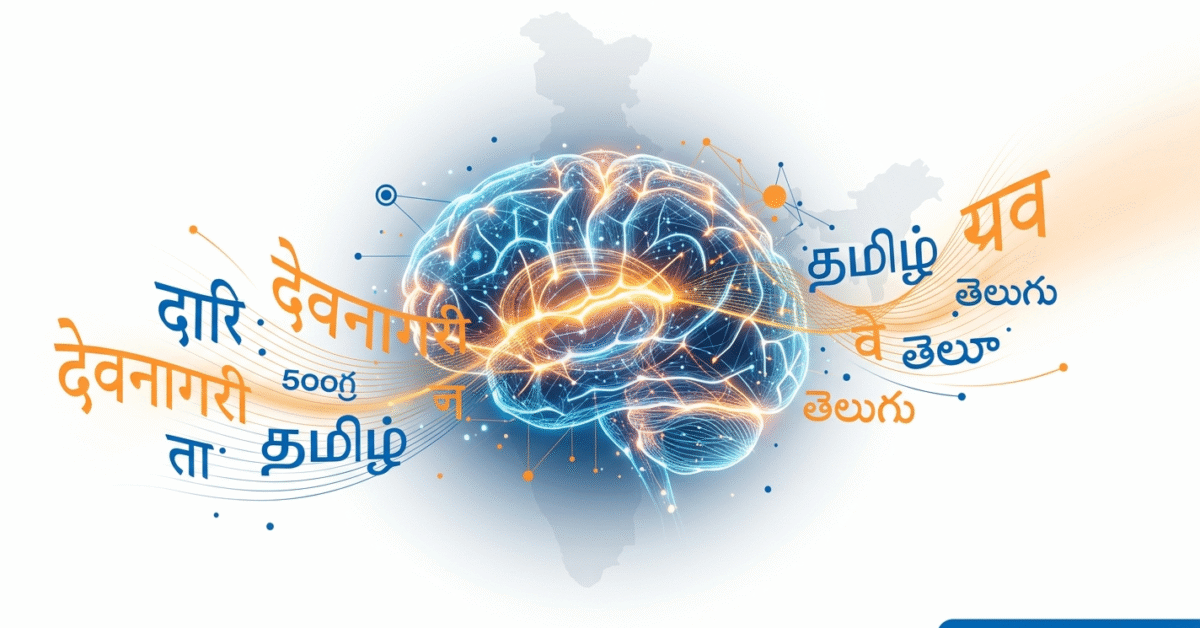
A Bengaluru startup just raised $234 million to build AI that speaks Hindi, Tamil, and Telugu. Read that again — while OpenAI and Anthropic burn billions chasing English-language supremacy, Sarvam AI became India’s newest unicorn by betting on the 1.4 billion people those companies ignore.
The smartest money in Indian tech just told Silicon Valley its entire AI strategy is fundamentally broken.
HCLTech didn’t write a $150 million check because they believe in “the future of AI.” They wrote it because they’ve watched American AI companies spend five years building products that 83% of the world’s population can’t properly use.
That’s not innovation. That’s colonial-era thinking dressed up in transformer architecture.
The $1 Billion Language Bet
Sarvam AI crossed the $1 billion valuation threshold in May 2025. The company is barely two years old.
Its Series B round pulled in participation from Lightspeed Venture Partners, Peak XV Partners, and Khosla Ventures — firms that collectively manage over $50 billion in assets. These aren’t charity donations. These are calculated bets that India’s approach to AI will generate returns that English-first models never will.
Here’s the math that should terrify every American AI executive: India has 22 officially recognized languages spoken by populations larger than most European countries. Hindi alone has 600 million speakers. Tamil has 75 million. Telugu has 82 million. Bengali has 230 million.
And here’s the kicker — less than 10% of Indians are fluent in English.
Every major AI model from OpenAI, Google, and Anthropic was trained predominantly on English data. They bolt on multilingual capabilities as an afterthought.
Sarvam built its entire architecture around Indic languages from day one. That’s not a feature difference. That’s a fundamental philosophical divergence in how AI should work.
The consensus view that American AI companies will dominate globally is wrong because they’re optimizing for the wrong market.
What HCLTech Actually Bought
Let’s talk about what HCLTech actually bought with their $150 million. They didn’t buy equity in another chatbot company. They bought a strategic weapon.
HCLTech generates $13.8 billion in annual revenue. They employ over 227,000 people across 60 countries. Their clients include half the Fortune 500.
And they just signaled — loudly — that their AI future runs through Bengaluru, not San Francisco.
Shiv Nadar, HCLTech’s founder and one of India’s richest individuals, has spent decades watching Indian IT companies serve as back-office support for American technology. Wipro, Infosys, TCS — they all built empires on being cheaper, not better.
This investment marks a strategic pivot. HCLTech isn’t trying to be cheaper anymore. They’re trying to own the AI stack for the next billion users.
The Team Silicon Valley Can’t Replicate
Sarvam’s founding team reads like a who’s-who of Indian AI research. Vivek Raghavan and Pratyush Kumar built the company after years at Google and AI4Bharat, where they developed some of the most sophisticated Indic language models in existence.
These aren’t Stanford dropouts chasing hype. They’re researchers who spent a decade understanding why Western AI models fail catastrophically when processing Indian languages.
And fail they do. Run a complex Hindi query through GPT-4 and watch it hallucinate. Ask Claude to summarize a Tamil legal document and observe the errors cascade.
These models weren’t trained on enough Indic data to handle the linguistic complexity. They don’t understand code-switching — the way Indians seamlessly blend English words into Hindi sentences. They can’t parse the contextual nuances that change meaning entirely.
Sarvam’s models don’t have these problems because they were never designed for English speakers who occasionally need translation.
India’s AI Unicorn Boom
Here’s what nobody’s saying: India’s AI unicorn boom is a direct response to Silicon Valley’s arrogance, and the market is pricing it accordingly.
In the past 18 months, Indian AI startups have raised over $1.2 billion. Krutrim hit unicorn status. Ola’s AI division is scaling. Now Sarvam joins the billion-dollar club.
This isn’t random venture capital enthusiasm. This is capital flowing toward a massive market inefficiency that American companies created through their own myopia.
The Indian AI market is projected to hit $17 billion by 2027. That’s a compound annual growth rate of 25-30%.
And here’s the part that should make every global AI company nervous — Indian enterprises are increasingly choosing domestic AI solutions over American imports.
Why? Because a language model that actually understands your customer service queries in Marathi generates more value than a “superior” model that requires everything translated to English first.
Because an AI that can process Hindi legal contracts without errors saves more money than a technically impressive system that needs human verification on every output.
Reliance is building AI infrastructure. Tata is investing in AI research. Infosys is developing proprietary models.
The entire Indian tech establishment has decided — almost simultaneously — that depending on American AI is a strategic vulnerability they’re no longer willing to accept.
Sarvam’s $234 million round is the clearest signal yet that this isn’t nationalism masquerading as strategy. It’s cold, hard capitalism recognizing that the AI company that owns India’s linguistic diversity owns a market larger than the United States and Europe combined.
The Competitive Battlefield
Let’s examine the competitive dynamics that make this investment particularly savage.
Google has spent years trying to crack Indian languages. Their results are mediocre at best. They’ve thrown compute, researchers, and billions of dollars at the problem.
Their Hindi models still struggle with basic comprehension tasks that Sarvam handles effortlessly.
Meta’s open-source play with Llama gave Indian developers access to foundation models they could fine-tune. Sarvam used this to their advantage — building on open architectures while adding proprietary layers that capture linguistic nuance.
They’re not competing with Meta. They’re standing on Meta’s shoulders while building something Meta can’t replicate.
Amazon and Microsoft are fighting for Indian cloud market share. They need local AI capabilities to win enterprise contracts. Neither has the Indic language expertise that Sarvam has spent years developing.
Watch for acquisition attempts within 24 months.
The Strategic Partnership Structure
The funding round’s structure reveals the strategic thinking. HCLTech’s $150 million represents 64% of the total raise. That’s not a passive investment.
That’s a partnership designed to integrate Sarvam’s technology across HCLTech’s entire service delivery infrastructure. Every client engagement, every enterprise deployment, every customer interaction — all potentially powered by Sarvam’s language models.
Lightspeed and Peak XV (formerly Sequoia India) have both made multiple bets in the Indian AI space. Their participation signals that Sarvam has differentiated itself from the dozens of other Indian AI startups competing for attention.
Khosla Ventures’ involvement adds Silicon Valley credibility while reinforcing that even American VCs recognize the opportunity.
The Valuation Math
The valuation math tells a story the headlines don’t capture.
At $1 billion, Sarvam is valued at roughly 4.3x the capital raised. That’s aggressive for a two-year-old company in a market where AI valuations have compressed significantly since 2023.
Investors are paying a premium because they believe Sarvam has something defensible — and in AI, defensibility is rare.
The moat isn’t the technology. Transformer architectures are well-understood. The moat is data and expertise.
Sarvam has accumulated training data in Indic languages that would take competitors years to replicate. They have researchers who understand linguistic patterns that don’t exist in English. They have relationships with Indian enterprises that American companies can’t easily penetrate.
This is the same playbook that made Baidu dominant in Chinese search while Google floundered. It’s the same dynamic that let WeChat crush WhatsApp in China.
Local expertise, local data, local relationships — these advantages compound over time in ways that raw technical capability cannot overcome.
Here’s the uncomfortable truth for global AI companies: You cannot buy your way into linguistic and cultural understanding.
You can acquire startups. You can hire researchers. You can license data. But the institutional knowledge required to build AI that truly serves non-English speakers takes years to develop.
Sarvam has that head start. Their competitors don’t.
Government Support Without Interference
The Indian government is paying attention. The Ministry of Electronics and Information Technology has made AI a strategic priority.
They’re funding research, creating regulatory sandboxes, and actively encouraging domestic AI development. Unlike China’s approach — which involves heavy-handed state control — India is letting market forces drive innovation while providing supportive infrastructure.
This creates a favorable operating environment for companies like Sarvam. They get government support without government interference. They can access global capital while serving local needs.
They benefit from India’s massive engineering talent pool without the geopolitical complications that Chinese AI companies face.
Perfect Timing
The timing of this funding round is not coincidental.
AI investment globally has become more selective. The era of throwing money at anything with “AI” in the pitch deck ended in 2023.
Investors now demand clear paths to revenue, defensible technology, and realistic market opportunities. Sarvam checked all three boxes.
Their enterprise focus means revenue visibility. Their language-first approach means technical differentiation. Their Indian market focus means a massive, underserved opportunity.
This is exactly the profile that attracts capital in a tightening funding environment.
The round also comes as Indian IPO markets have shown renewed appetite for technology companies. Zomato, Nykaa, and other Indian tech firms have demonstrated that domestic investors will pay premium valuations for companies with strong growth trajectories.
Sarvam’s path to public markets is now clearly visible — likely within 3-4 years if current growth continues.
What to Watch
Enterprise contract announcements over the next 6 months: HCLTech will start deploying Sarvam’s technology across client engagements. Watch for major Indian enterprises — banks, telecoms, government agencies — announcing Sarvam partnerships. Each contract validates the technology and expands the data advantage.
Competitive responses from Google, Microsoft, and Amazon: These companies cannot afford to cede the Indian enterprise AI market. Expect accelerated Indic language initiatives, potential acquisition approaches, or partnership proposals. How Sarvam navigates these overtures will determine whether they remain independent or become absorbed into a larger platform.
Regulatory developments around AI data localization: India has been considering data localization requirements that would force AI companies to process Indian data within Indian borders. If implemented, this would massively advantage domestic players like Sarvam while creating significant compliance burdens for American competitors.
The Bottom Line
The venture capital narrative around AI has been dominated by American exceptionalism for too long. The assumption that whoever builds the most powerful English-language model wins the global market was always flawed.
Sarvam’s unicorn status proves that the market has finally recognized this reality.
India’s newest AI unicorn didn’t become a billion-dollar company by building better technology. It became a billion-dollar company by building the right technology for the right market at the right time.
HCLTech’s $150 million bet is a declaration that the future of AI isn’t monolingual. It’s not centered in San Francisco. And it’s definitely not going to be won by companies that treat 1.4 billion people as an afterthought.
The AI industry just got a $234 million wake-up call. The question now is whether anyone in Silicon Valley is listening — or whether they’ll keep building for the 10% while companies like Sarvam capture everyone else.
About the author

Ahad Waseem is a writer, entrepreneur, investor, and content creator. He’s a business and technology expert and writes for a number of prestigious internet publications. Ahad holds a particular interest in politics, economics, and philanthropy and has been featured in Miami Herald, The Sun News, The State, Charlotte Observer, and the Centre Daily Times. He is also launching a nonprofit organization to transform societal norms in South Asia.